How To Choose A Leather Bag And The Right Crossbody Strap
A leather bag is one of the few everyday accessories that can genuinely improve with time, but only if you choose well at the start. Beyond leather quality and design, the comfort and usability of a handbag often comes down to the strap: how it sits on your body, how it distributes weight, and how easily it adjusts to different outfits and seasons.

In this article, we will explore how to choose a leather bag with the right capacity and construction, understand key leather grades, and select a crossbody strap based on real fit measurements like drop and length. You will also learn how to evaluate strap width, hardware compatibility, and replacement strap options so your bag remains comfortable and functional for years.
No. 1
A Three-Step Filter Before You Shop
Before you compare colors, silhouettes, or hardware finishes, narrow the field with three practical questions. This reduces impulse decisions and helps you focus on bags you will actually use.
Capacity and weight: choose what supports your routine
Start with your daily carry. Many bags fail not because they are poorly made, but because they do not match what you truly need to bring with you.
Use this quick checklist to assess capacity:
Wallet or card case
Phone
Keys
Sunglasses or glasses case
Small pouch for essentials
Water bottle
E-reader or tablet
Charger, lipstick, hand cream, or medication
Then add two simple steps:
Measure the longest item (often a water bottle or tablet) and compare it with the interior dimensions listed by the seller.
Consider weight creep: a larger bag often encourages you to carry more, which can strain your shoulder and the bag’s attachment points over time.
If you tend to commute or travel between meetings, it may be worth choosing a bag with slightly more capacity than you need on weekends, but avoid “oversizing” as a default. Comfort is easier to maintain when the bag is not constantly loaded.
Durability cues: spot quality in photos and descriptions
You do not need to be a leather expert to recognize strong construction. Focus on high-stress areas and components that are expensive to repair.
Look for these durability cues:
Reinforced stitching where handles or straps meet the body
Clean, finished edges (especially on strap ends and seams)
Smooth zipper movement and aligned teeth
Solid-feeling clasps and snaps that do not look flimsy
Attachment points (D-rings, loops, hooks) that appear thick and secure
Pay special attention to strap attachment points, since they bear repeated load every day. If a listing does not show clear photos of rings, clasps, or stitching, that is a reason to pause and request more detail before buying.
Carry style: match the strap setup to your real preferences
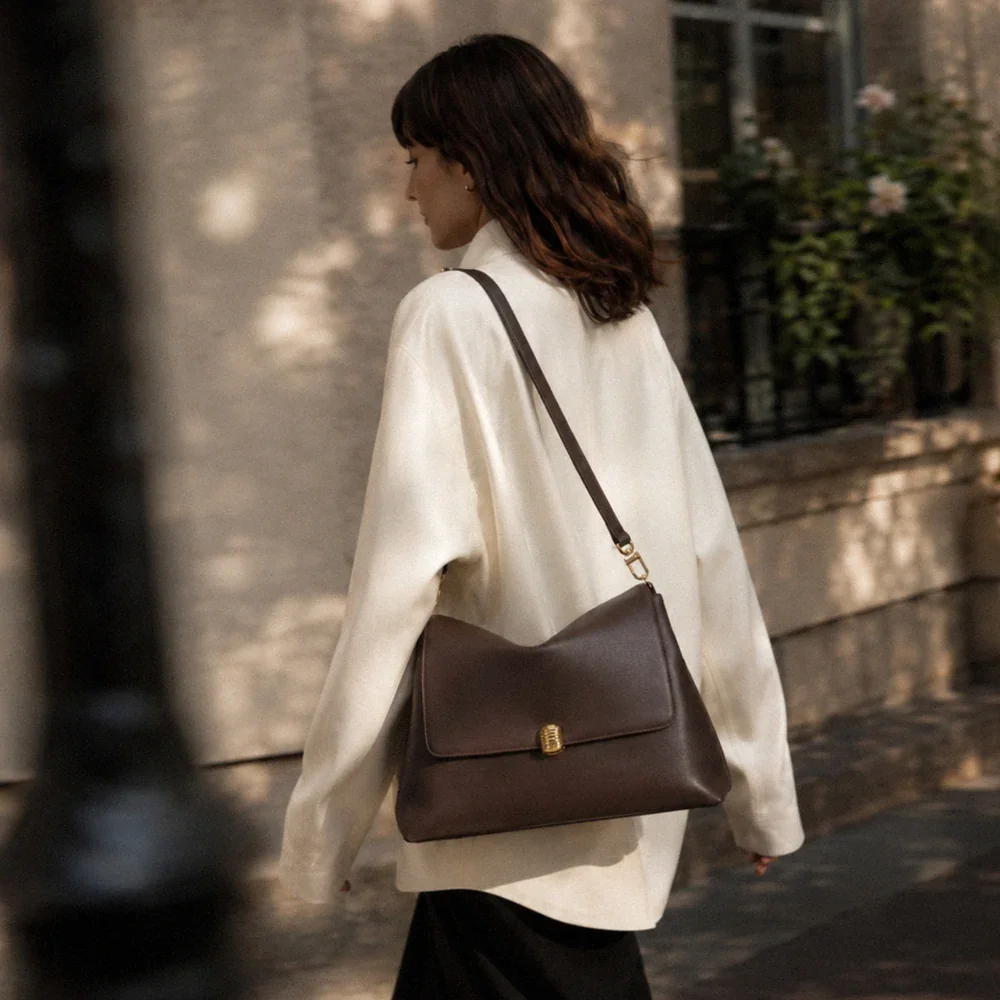
Handheld, shoulder, and crossbody bags are not interchangeable unless the strap system supports each style.
If you want flexibility, prioritize:
Removable straps
Sturdy D-rings or side loops
Enough strap length for crossbody wear
A comfortable strap width for the bag’s typical load
A bag can look perfect but feel irritating in use if the strap options do not match how you move through your day. If you routinely walk, commute, or keep your hands free, crossbody comfort becomes a core feature, not a bonus.
No. 2
Leather Basics in Two Minutes
Leather terminology can be confusing because many labels are broad and not tightly regulated. The goal is not to memorize every term, but to understand what you are likely getting when you see common categories.
Full-grain, top-grain, and “genuine leather” explained
Full-grain leather retains the outermost layer of the hide, including small natural marks. It is often chosen for its durability and the way it develops patina over time.
Top-grain leather has typically been sanded or treated to create a more uniform surface. Depending on the tanning process and finishing, top-grain can still be durable and attractive, but it may not age the same way full-grain does.
The label “genuine leather” only confirms that a product contains leather. It does not identify the part of the hide or guarantee a specific quality level.
How to compare leather bags more confidently
When comparing a leather bag, use a simple evaluation process:
Start on the brand’s landing page or product overview to find how they describe materials and construction.
Compare the stated leather grade and the bag’s measurements to your needs.
Look for details that suggest transparency: clear photos, thorough specifications, and an explanation of the leather type.
When you combine leather grade with hardware and stitching quality, you get a much more realistic picture of longevity than by relying on marketing language alone.
No. 3
Strap Fit: How to Get the Drop Right
Strap drop is one of the most useful measurements for predicting comfort, because it helps you estimate where the bag will sit when worn. Graf Lantz uses this definition in its size chart, and Bouclier describes the measurement in similar terms.
Drop is the vertical distance from the top of the bag to the highest point of the strap when the bag hangs naturally. While drop helps you estimate placement, keep in mind that bag depth, strap stiffness, and your body shape can shift the final resting position.
How to estimate strap drop at home before ordering
This at-home method is quick and more reliable than guessing from photos:
Decide where you want the top of the bag to sit, such as at your waist or hip.
Use a bag you already own and adjust it to that position, or use cord or a belt to represent a strap.
Lay the strap or cord flat and measure it using the same method shown by the seller.
Add extra length if you plan to wear the bag over a winter coat or thick sweater.
If you are between two sizes or strap options, choose the one that offers adjustability. It is easier to shorten a strap than to make an overly short strap work, especially in colder months.
No. 4
Strap Length and Drop Are Not the Same
Many shoppers assume strap length and drop are interchangeable. They are not, and confusing them is one of the most common reasons crossbody straps disappoint.
End-to-end strap length includes the hardware and is measured with the strap laid flat. Drop is measured from the top edge of the bag to the highest point of the hanging strap. Product listings may provide one or both numbers, so check the seller's measurement method before ordering.
Mautto's fit guide places a typical crossbody strap length at about 50 inches (127 cm), but the right length depends on your height, torso, bag size, and preferred position.
A practical way to choose strap length
Use this decision framework:
If you want the bag to sit higher and closer to your waist, you likely need a shorter setting.
If you want it to rest at the hip or slightly below, you need more length.
If you alternate between crossbody and shoulder carry, adjustability becomes essential.
If you wear structured outerwear in winter, plan for added bulk.
An adjustable strap is the most flexible choice because it can accommodate seasonal layers and different carrying positions without forcing awkward placement.
No. 5
Width, Hardware, and Other Practical Details
Once you know the right general length and drop, the next comfort variable is strap width. Width affects weight distribution, stability, and how the strap feels over time.
Strap width: balance comfort and aesthetics
Strap width involves a trade-off between appearance and comfort. Mautto notes that wider straps spread weight across a larger area, which can make a loaded bag more comfortable.
Use these guidelines:
Narrow straps can work well for small, lightweight bags and evening styles.
Medium-width straps are a versatile choice for daily carry.
Wider straps are often best for larger bags, work bags, and anything you routinely load with heavier items.
Also consider chain straps. Chain can look elegant, but it may press into your shoulder when the bag is full. A removable leather shoulder pad may help during longer periods of wear.
Hardware compatibility: measure before you buy a replacement strap
Compatibility depends on both the bag's rings and the clasp opening. Foley + Corinna's guide recommends measuring the D-rings or loops, which commonly come in widths such as 1, 1.25, or 1.5 inches (25, 32, or 38 mm). Also confirm that the clasp can open far enough to fit over the ring without twisting.
To avoid ordering the wrong strap, check:
The internal width of the bag’s D-rings or loops
The strap width at the clasp end
The clasp gate opening (will it fit over the ring smoothly?)
Whether the strap hardware finish matches the bag (if appearance matters to you)
Replacement straps: shop with a quick checklist
If you need a replacement strap, the Moonshaft accessories collection presents strap widths, colors, and prices together. At the time of viewing, it included detachable leather straps in 20 mm and 35 mm widths.
When comparing replacement straps, consider:
Width relative to your bag size and typical load
Adjustability range for crossbody and shoulder use
Leather stiffness (softer can be more comfortable, stiffer can feel more structured)
Edge finishing and stitching quality
Hardware strength and smooth clasp action
After attaching any replacement strap, close both clasps fully and give the strap a firm tug before loading the bag. This simple test can prevent drops caused by incomplete closure or a clasp that is not seated correctly.
No. 7
Care and storage
Remove surface dust with a soft, dry cloth before it builds up in seams or along handles.
For marks, use a cleaner intended for the specific type of leather and test it first on a hidden area.
Apply conditioner sparingly, since overconditioning can darken some finishes or leave a residue.
Use a brush attachment on low suction to remove debris from a fabric lining, especially along corners and the base where grit collects.
Consumer Reports recommends storing handbags in canvas dust covers or clear dustproof bags between uses. To help the bag hold its shape and avoid creases that can become permanent over time, lightly stuff the interior with acid-free tissue or clean fabric.
Store the bag upright in a cool, dry place away from direct sunlight and heat sources. Avoid leaving it hanging by the strap for long periods, because that can strain attachment points, distort the top line, and accelerate wear where hardware meets leather.
No. 8
A 60-second try-on checklist
Load the bag with your usual daily items before judging its weight.
Make sure you can reach the main opening without fully removing the bag.
Check whether the strap edge presses into your shoulder or neck.
Walk a few steps and note whether the bag bounces or swings forward.
Confirm that the clasps close fully and sit securely in the rings.
Check where the bag lands when you stand, sit, and bend down.
Before ordering a replacement crossbody strap
Before ordering a replacement crossbody bag strap, compare the collection's displayed width, color, and price with your bag's D-rings, and check the listing again since details can change.
Use this quick pre-order check to reduce the chance of returns and fit problems:
Measure the internal width of your bag’s D-rings or loops so the strap hardware can move freely without binding.
Confirm the clasp opening is wide enough to clip on without forcing or twisting.
Match strap width to how much you typically carry, since a heavier load benefits from more surface area on the shoulder.
Re-check the listing right before purchase, since available widths, colors, and pricing can change.
FAQ
What crossbody length works for someone petite or tall?
There is no single length based on height alone. Torso length, bag size, clothing thickness, and your preferred carrying position all affect where the bag lands.
For the most reliable fit, measure a strap or bag that already feels comfortable and compare it with the seller's listed drop or total strap length. An adjustable strap offers the easiest way to fine-tune the fit across different outfits and seasons.
Can I put a wider strap on any bag?
Not always. Start by measuring the bag's D-rings or loops and then check the size and opening of the replacement clasps.
The clasp must fit over the ring, close completely, and move without forcing the ring into an awkward angle. If the strap is wider than the ring or the clasp binds, the hardware can wear faster and the bag may hang unevenly.
Should I store a bag with the strap attached?
For long-term storage, remove a detachable strap if the hardware allows. Place it inside the bag or store it alongside the bag so it stays paired without pulling on the attachment points.
Avoid hanging the bag by its strap for extended periods, since that can strain the hardware, stretch the leather at stress points, and distort the bag’s shape over time.
Takeaways
A leather bag is worth choosing slowly, because comfort and durability depend on more than style. Start by matching capacity to your daily carry, then assess construction details like stitching, edge finishing, and hardware strength.
Strap measurements are the key to fit, and drop is not the same as end-to-end length. Use an at-home measuring method and prioritize adjustability so your bag remains comfortable across seasons and outfits.
Finally, treat strap width and hardware compatibility as practical essentials, not afterthoughts. Measuring your bag’s rings and checking clasp fit helps you choose straps that are secure, comfortable, and built for real daily use.
Looking for resources?
At Hello Lovely Living, we aim to empower you to earn and save money and time while benefiting from our expansive network of home, life, wellness, travel, work-from-home, career, and business resources and opportunities. Discover a wealth of tools to support your journey.