The Ultimate Albania Road Trip
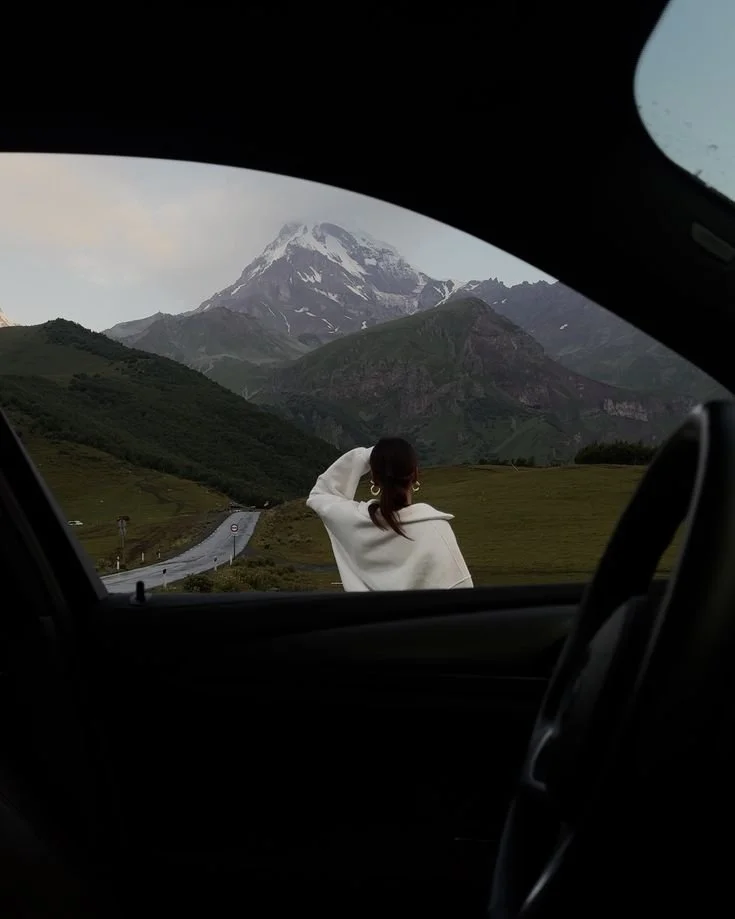
There is a particular kind of freedom that only a road trip can deliver — the ability to stop at a roadside stall because the tomatoes looked too good to pass, to take a detour because a sign pointed toward a waterfall with a name you can't pronounce, and to arrive somewhere extraordinary without ever having planned to. Albania, it turns out, is the perfect country for exactly that kind of travel.
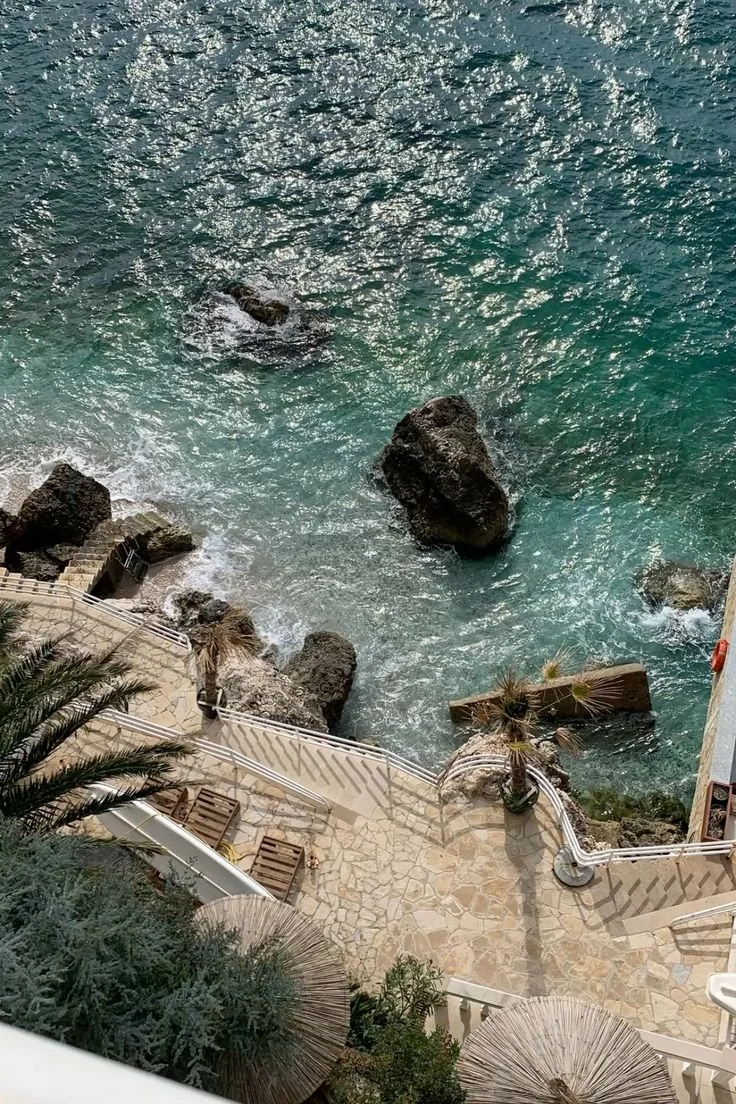
Sandwiched between Montenegro, Kosovo, North Macedonia, and Greece, and kissed by both the Adriatic and Ionian seas, Albania packs an almost absurd amount of scenery, history, and flavor into a country roughly the size of Maryland.
Ancient ruins sit beside Ottoman bazaars. Mediterranean beaches give way — within an hour's drive — to alpine peaks that feel genuinely wild. And unlike much of southern Europe, Albania is still affordable, still relatively uncrowded, and still genuinely surprising.
The catch? Public transport here will only take you so far. Buses link the big cities well enough, but the mountain passes, hidden beaches, monastery trails, and UNESCO village lanes that make Albania extraordinary are almost impossible to reach without your own wheels. A road trip is not simply the best way to see Albania. For large parts of the country, it is the only way.
In this article, you’ll find a complete 10-day, start-to-finish driving loop that begins and ends in Tirana, covering the Adriatic Coast, the Albanian Riviera, UNESCO cities in the south, the wild mountain interior, and the lake district to the east. It’s designed to be driven, savoured, and repeated.
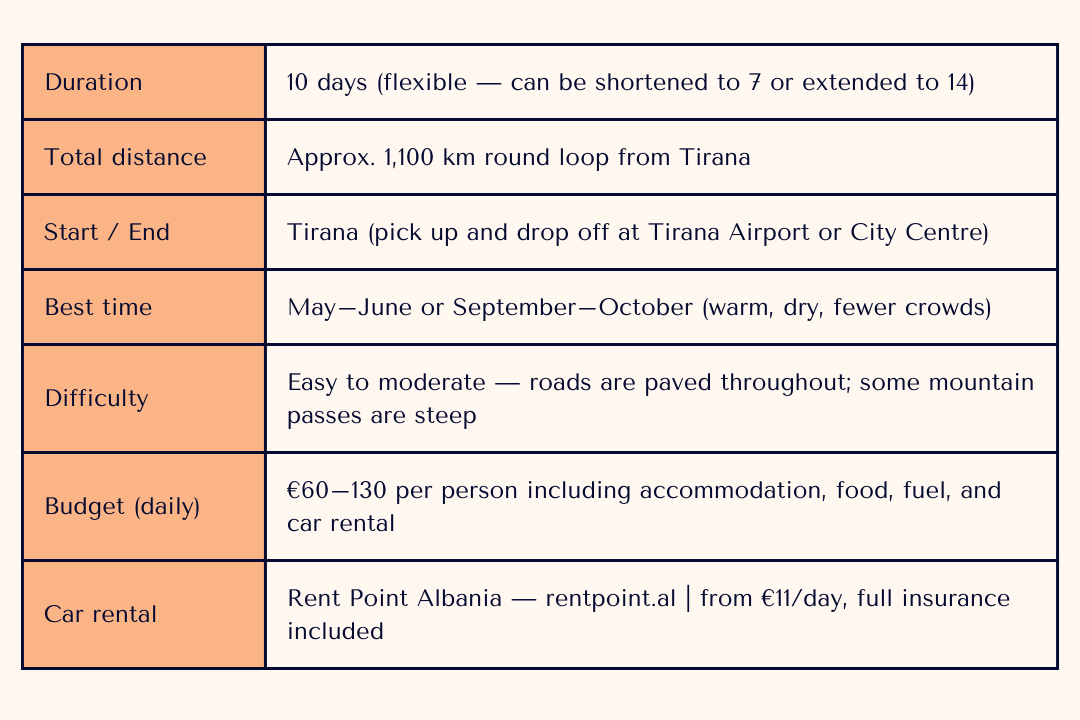
Trip At a Glance
Step One: Getting Your Car
Every great road trip begins before the engine turns over — with the right vehicle. For this itinerary, which mixes coastal motorway stretches with mountain passes and village lanes, a compact SUV strikes the ideal balance: enough ground clearance for gravel sections near Theth or Valbona, enough fuel efficiency to keep costs sensible, and enough space for two people and luggage to travel comfortably.
We recommend booking through Rent Point Albania, which operates out of Tirana International Airport (TIA), Tirana City, and Durres Port. They can also deliver a vehicle to your hotel or accommodation address within a 30 km radius — a genuinely useful option if you’re arriving late and want to skip the airport counter queue entirely.
What sets Rent Point Albania apart from the international chains is the transparency. Every rental includes full Kasko insurance, unlimited kilometres within Albania, and VAT — no asterisks, no hidden fees at collection. Their fleet runs from compact city cars (from €11/day) up to 9-seat passenger vans for groups, with mid-range SUVs like the Skoda Karoq, Seat Arona, and Kia Stonic sitting comfortably in the €19–27/day bracket. For a 10-day road trip, that works out cheaper than most people expect.
Rent Point Albania — Practical Details
Pickup locations: Tirana Airport (TIA) · Tirana City · Durres Port · Custom address (within 30 km)
Fleet highlights: Kia Stonic / Seat Arona (SUV, from €19/day) — ideal for this itinerary
Included in price: Full Kasko insurance · Unlimited km · VAT · 24/7 roadside assistance
Documents needed: Passport + driving licence. No International Driving Permit required.
Cross-border trips: Green Car Insurance available for €40. Border crossing fee: €30.
Book online: rentpoint.al | WhatsApp / Call: +355 695 875 689
Tip: They have waited over two hours at the airport for delayed flights at no extra charge — multiple guests have noted this in reviews.
The Route: Day by Day
This loop is designed to be driven anticlockwise — north and west before swinging south and looping back east. Anticlockwise keeps the sea on your right (passenger) side for the coastal stretches, making photography easier from the driver's perspective, and saves the mountain interior for the second half when your eye is already calibrated for Albanian scenery.
Day 1 — Tirana: Before You Leave the Capital
Pick up your car in the morning — Rent Point Albania's Tirana city office is centrally located and easy to reach from any hotel in Blloku or the city centre. Don’t bolt north immediately. Tirana is a better city than its reputation among road-trippers suggests, and a morning here sets the tone for the trip.
Start with breakfast at the National Museum of History's cafe on Skanderbeg Square — good espresso, extraordinary facade. Walk the colourful apartment blocks of Blloku, the former Communist-era Party of Labour quarter now packed with cafes and independent shops.
Visit the Pyramid, Enver Hoxha's former mausoleum, which is now a youth arts and climbing centre. By noon, you’ll have a working sense of where Albania has been and where it is going.
Drive north in the afternoon: the A1 motorway to Shkoder is 110 km and takes about 90 minutes on smooth tarmac. Shkoder is your base for the first night and your gateway to the Albanian Alps.
Stay: Shkoder — guesthouses in the old town from €25/night
Drive: Tirana to Shkoder, 110 km / ~1.5 hrs via A1
Don't miss: Rozafa Castle at sunset — medieval fortress above the confluence of three rivers, free to wander
Day 2 — The Albanian Alps: Theth Valley
This is the day that recalibrates your understanding of what a road can be. The drive from Shkoder to Theth covers 72 km but takes around 2.5 to 3 hours — the road climbs over the Qafa e Thorës pass at 1,200 metres on a surface that alternates between repaired tarmac and cheerful improvisation. It is spectacular and entirely manageable in a standard SUV. A low-clearance city car would suffer; anything with decent suspension will do fine.
Theth village sits in a valley so cinematic it looks assembled from a greatest-hits catalogue of alpine clichés — except everything here is entirely genuine. The kulla (stone tower houses), the orthodox church in the meadow, the glacial streams, the eagles riding thermals above the treeline. There are no chains here, no tour buses from cruise ships. The guesthouses are run by the same families that built the kulla.
Do: Walk to the Blue Eye spring (Syri i Kaltert) — 2 km from the village, startlingly clear turquoise water
Do: Hike to the Grunas Waterfall — 45 min return, easy trail
Do: Ask your guesthouse host about the Kulla e Ngujimit — the old blood-feud refuge tower, with a story that goes deep into Albanian customary law
Stay: Theth — family guesthouses, meals included, €30–40/night
Note: The road to Theth may be impassable November to April — check local conditions if visiting in shoulder season.
Day 3 — Valbona to Shkoder: The Other Side of the Pass
The full-day hike from Theth to Valbona over the 1,800 m Valbona Pass is one of the finest alpine walks in the Balkans. But this is a road trip guide — so here is the driver's alternative: backtrack to Shkoder and take the southeastern road to Bajram Curri, then drop down into the Valbona Valley from the north. It adds distance but delivers views of the Accursed Mountains (Bjeshket e Nemuna) from a completely different angle, and the valley itself — pine forests, the Valbona River, traditional guesthouses — rewards the detour.
In the afternoon, loop south back toward the coast via the lake road past Koman. If time allows, consider the Koman Lake ferry — a three-hour journey through drowned canyon scenery that is widely described as one of the most dramatic boat rides in Europe. It does not fit into a strict driving itinerary, but if your schedule has a day to spare, divert here.
Drive: Theth–Shkoder–Bajram Curri–Valbona: ~180 km, ~4 hrs
Alternative: Book the Koman Lake ferry (departs 9am daily) and arrange car transport separately — feasible with advance planning
Day 4 — The Adriatic Coast: Durres to Vlora
Drop back to the SH1 coastal road and head south. Durres is Albania's main port city and a functional transit point rather than a destination — but the Roman amphitheatre in its city centre (one of the largest in the Balkans, still partially buried beneath apartment blocks) is worth 45 minutes of your time. The attached archaeological museum has recently been renovated and is excellent.
South of Durres, the Adriatic coast road rolls through a patchwork of beach resorts — some overdeveloped, some genuinely lovely — before arriving at Vlora, the city where Albania declared independence in 1912. The Independence Museum is compact and well-curated. The seafront promenade, lined with palm trees and cafes facing the bay, is the right place to eat dinner.
Drive: Shkoder to Durres (~100 km, 1.5 hrs) then Durres to Vlora (~148 km, 2 hrs via SH4 coastal)
Stay: Vlora — hotels from €40/night, seaside rooms worth the premium
Don't miss: Kanina Castle above Vlora — a Byzantine fortress with panoramic views of the bay, 7 km inland, largely unvisited
Day 5 — The Albanian Riviera: Vlora to Saranda
This is the day most road-trippers will talk about for years. The Llogara Pass (1,027 m) rises from sea level in 20 km of hairpin bends through pine forest, then descends to the Ionian coast on the other side. The view from the top — where a cluster of restaurants and a national park visitor centre mark the summit — stretches south along a coastline that genuinely rivals the Amalfi and Croatian coasts at a fraction of the price and with a fraction of the crowds.
The Albanian Riviera runs from Palasa in the north to Ksamil in the south, threading through villages like Dhermi, Himara, and Borsh along a road that winds between cliffs and turquoise coves. Stop at Gjipe Beach (a 40-minute walk from the roadside parking area, worth every step), swim at Drymades, eat grilled fish at a family taverna in Himara overlooking the water. This is what the Riviera is for.
End the day in Saranda — the southernmost resort town, overlooking Corfu, just 27 km across the channel.
Drive: Vlora to Saranda via the Riviera: ~135 km, 3+ hrs (allow all day)
Must stop: Llogara Pass viewpoint, Gjipe Beach, Himara town
Stay: Saranda — wide choice from hostels to boutique hotels, €35–80/night
Day 6 — Butrint and Ksamil: Ruins and Turquoise Water
Saranda earns a second day. Drive 18 km south to Butrint, a UNESCO World Heritage Site that layers Greek, Roman, Byzantine, Venetian, and Ottoman history on a forested peninsula between a lagoon and the Vivari Channel. Butrint is one of the most beautifully situated archaeological sites in Europe and startlingly uncrowded given its quality — you can walk through Roman mosaics and a perfectly preserved Greek theatre with almost no one else around.
Return via Ksamil, a cluster of tiny islands and beaches that look engineered by a graphic designer trying to make a point about colour temperature. The water is genuinely that blue. Boat hire to the islands runs about €5 return. Lunch at one of the family-run restaurants on the beach road — grilled octopus, tzatziki made with Albanian mountain yogurt, cold Albanian beer.
Drive: Saranda to Butrint: 18 km / 25 min
Entry: Butrint National Park, approx. €8 — worth twice the price
Don't miss: The Venetian Tower at the channel crossing and the Lion's Gate inside the park
Day 7 — Gjirokastra: The Stone City
Turn inland and north. Gjirokastra is 54 km from Saranda on a winding road that climbs into the mountains and delivers you to one of the most architecturally intact Ottoman-era cities in the world. The whole old town is UNESCO-listed, and for once, that designation actually understates the case. The stone houses here — each one a small fortress, tiered up the hillside below the castle — have slate roofs that seem to grow directly from the rock.
The castle dominates everything from above, housing a military museum with a captured US Air Force plane from the Cold War (Albania shot it down in 1957; the US denied it existed). Below, the bazaar is genuinely functioning — silversmiths, tailors, cheese vendors — rather than a tourist performance. Eat at one of the traditional tavernas serving qofte (spiced minced meat), fergese (peppers and white cheese), and local wine from the Permet valley.
Drive: Saranda to Gjirokastra: 54 km / ~1 hr
Stay: Gjirokastra old town — stone guesthouses from €30/night, several with castle views
Allow: A full afternoon and the next morning — Gjirokastra is unhurried and rewards slow walking
Day 8 — Permet, Berat, and the Osum Canyon
The road east from Gjirokastra to Permet runs along the Drino Valley through a landscape of olive groves, stone villages, and distant snow-capped peaks. Permet is a small town famous for two things: its roses (the basis of a local liqueur called Rakia Trumce) and its access to the Benja Thermal Pools — natural hot springs at 32°C in a river gorge, accessed by a swaying suspension bridge, free to use, and busy only on summer weekends.
North of Permet lies Skrapar and the Osum Canyon — 26 km of near-vertical limestone walls carved by the Osum River, Albania's answer to the Grand Canyon. Rafting is available from March through June. Year-round, the canyon rim walk from Corovode offers views that require recalibration of your sense of scale. Continue northwest to Berat by evening.
Drive: Gjirokastra to Permet: ~60 km / 1.5 hrs. Permet to Berat via Skrapar: ~110 km / 2.5 hrs
Stop: Benja Thermal Pools (12 km from Permet town on a partially unpaved road)
Stay: Berat — the UNESCO-listed 'City of a Thousand Windows,' hotels and guesthouses from €30/night
Day 9 — Berat and the East: Lake Ohrid Corridor
Berat deserves its UNESCO listing twice over. The Mangalem quarter, a cluster of Ottoman houses above the Osum River, faces the Gorica quarter across the water — each window of the traditional houses subdivided into smaller panes in a style that has made this city the subject of more architectural essays than you might expect. The Castle above contains several Byzantine churches with intact frescoes and a handful of families who still live within the walls, as they have for centuries.
In the afternoon, head east toward the Lake Ohrid corridor — specifically the Albanian shore of Lake Ohrid near Pogradec, a lakeside town that sees a fraction of the visitors that the Macedonian side receives. The lake is one of the oldest in the world (over 5 million years), extraordinarily clear, and home to species found nowhere else on earth. Eat grilled Ohrid trout (koran) by the water before turning in.
Drive: Berat to Pogradec: ~105 km / 2 hrs
Stay: Pogradec — lakeside hotels from €35/night
Must eat: Koran (Ohrid trout) — the lake's signature fish, grilled whole with lemon and olive oil
Day 10 — Elbasan, Kruja, and Back to Tirana
The final morning allows a run north through Elbasan — an industrial city that hides a remarkably intact Ottoman bazaar inside the walls of a 15th-century Byzantine castle — before the last proper stop of the trip: Kruja.
Kruja is 32 km north of Tirana and the closest thing Albania has to a national shrine. The castle houses the Skanderbeg Museum, dedicated to Gjergj Kastrioti, the 15th-century Albanian nobleman who united the country's feudal lords and held off the Ottoman Empire for 25 years. The bazaar below the castle sells kilims, copperwork, antiques, and embroidery — the quality of the genuine article significantly higher than anything available in the capital's souvenir shops.
Return to Tirana in the afternoon. Drop the car at the airport or city office with Rent Point Albania, review what you covered in 10 days, and start planning the return visit.
Drive: Pogradec to Elbasan: ~55 km / 1 hr. Elbasan to Kruja: ~85 km / 1.5 hrs. Kruja to Tirana: 32 km / 40 min
Note: The Elbasan castle bazaar is most lively on weekday mornings — time your visit accordingly
Driving in Albania: What to Know
Roads
Albania's main roads have improved dramatically over the past decade. The A1 and A2 motorways (Tirana to Shkoder, Tirana to Durres) are excellent. National roads linking major cities are generally paved and in good condition. Mountain roads — particularly to Theth, into the Valbona Valley, and on the approach to some Riviera beaches — are narrower, sometimes unpaved, and require more attention. An SUV handles all sections of this itinerary comfortably.
Rules and customs
Speed limits: 130 km/h on motorways, 90 km/h on national roads, 40–50 km/h in towns
Seatbelts are compulsory front and rear. Fines are issued and enforced.
Drink-driving limit is 0.1g/L — among the lowest in Europe. Treat this as zero.
Priority is to the right at unmarked intersections. In practice, larger vehicles often assert priority; adjust accordingly.
Albanian drivers are decisive and confident. Follow local rhythm, don’t hesitate, and use your horn as a communication tool rather than an expression of frustration.
Petrol stations are plentiful in towns and along main roads. Fill the tank when you can in mountain areas.
Parking
Street parking in Tirana is marked with blue lines and costs around 50 lek/hour (under €0.50). Outside the capital, parking is almost entirely informal and free. At beaches and popular sites, unofficial attendants may appear — €0.50–1 is sufficient.
Emergency numbers
General emergency: 112
Police: 129
Road assistance/accident: Contact Rent Point Albania directly at +355 695 875 689
Planning Notes
When to go
May, June, and September offer the best combination of weather, road conditions, and manageable crowds. July and August are hot at the coast (35°C+) but comfortable in the mountain interior; beach spots get busy. March and April are beautiful, but some mountain roads remain closed. October is increasingly popular and rewards travelers with autumn color in the alpine areas.
Money
Albania uses the lek (ALL). Most tourist businesses also quote in euros, particularly for accommodation and car rentals. ATMs are widely available in cities and towns; rural areas and mountain villages are cash-only. Daily budget: €60–80/person is comfortable; €100+ is generous.
Accommodation
Albania has no major international hotel chains outside Tirana, which is entirely to its credit. Accommodation runs from family guesthouses (€20–40/night, meals often included) to boutique hotels in Berat, Gjirokastra, and Saranda (€50–100/night). Book ahead in July and August for coastal towns; elsewhere, arriving without a reservation is usually fine.
Language
Albanian (Shqip) is the official language and not closely related to any other European language, which makes basic courtesy phrases rewarding to learn and appreciated by locals. English is spoken by younger Albanians in tourist areas, and Italian is widely understood along the coast (Albania's closest cultural neighbour, historically). Greek is common in the south. Carry an offline translation app.
Takeaways
Albania rewards drivers in a way that few places in Europe still do: big landscapes, small surprises, and the sense that you’re travelling through a country that hasn’t been polished into predictability. This 10-day loop is built to give you range — from the switchbacks of the Llogara Pass to the stone streets of Gjirokastra, from the thermal pools near Permet to the deep calm of Lake Ohrid.
If you take one thing from this guide, let it be this: leave room for detours. Albania’s best moments are often the unplanned ones — the roadside fruit stand, the unmarked viewpoint, the village cafe where someone insists you try “just one more” homemade raki. Drive slowly, stay curious, and you’ll understand why this is the kind of road trip people don’t just remember — they return to.
Looking for Travel resources?
Looking to embark on a transformative journey to discover new cultures, expand your horizons, and reconnect with yourself? Explore, learn, and awaken your wanderlust with our travel partners designed to support you on your next getaway.