Why Your Backyard Feels Less Relaxing Than It Used To
Your backyard is supposed to be the easiest place to exhale. It’s where morning coffee tastes better, where evenings slow down, and where the noise of the day fades into birdsong, breezes, and familiar routines. Yet many homeowners reach a point where their outdoor space still functions—but it no longer feels like a retreat. It looks fine at a glance, but it doesn’t invite you to linger. You sit down, glance around, and something feels subtly “off.”

In this article, we’ll unpack the most common (and often overlooked) reasons a backyard loses its calming effect over time—ranging from visual clutter and discoloration to worn surfaces, broken transitions, and poor lighting. More importantly, you’ll learn practical, high-impact ways to restore a sense of peace without necessarily committing to a full renovation.
No. 1
The Hidden Impact of Visual Clutter
Visual clutter isn’t only about having “too much stuff.” It’s about too many competing signals in the same field of view. Even outdoors—where nature is typically soothing—your brain still tries to process patterns, group objects, and make sense of what belongs together.
Look around your yard and ask yourself:
Do you have mismatched chairs collected over the years?
Are tools, hoses, toys, or planters scattered across multiple zones?
Do décor items compete rather than complement (different styles, colors, materials)?
Are there “temporary” items that have become permanent (unused pots, spare pavers, broken umbrellas)?
Individually, these details feel minor. Collectively, they create visual noise, and your mind stays slightly alert trying to organize it. That low-level mental effort reduces the sense of restoration a backyard should provide.
How to reduce visual clutter (without making your yard sterile)
A calmer yard doesn’t require minimalism—it requires cohesion and intention.
Choose a simple color palette: Repeat 2–3 core colors across cushions, planters, and accents.
Group like items together: Create a defined storage area for garden tools, kids’ toys, or pool accessories.
Hide what you don’t use daily: Storage benches, deck boxes, and slimline sheds reduce scatter fast.
Replace “random décor” with a few statement pieces: Fewer items, chosen deliberately, read as designed rather than accumulated.
When your brain sees fewer “loose ends,” your body feels more at ease.
No. 2
Discoloration: The Slow Fade You Stop Noticing
One of the most powerful mood-drainers in an outdoor space is gradual discoloration—because it happens slowly enough that you adapt to it. Sun, rain, dirt, mildew, and seasonal debris don’t just make surfaces dirty; they alter the perceived age and energy of your backyard.
Over time, discoloration can make a space feel:
Dull instead of bright
Neglected instead of cared for
Heavy instead of airy
Uneven instead of clean-lined
Even if you keep things tidy, uneven color and staining can subconsciously signal “work to be done,” which is the opposite of relaxation.
Common signs your backyard is suffering from fading and buildup
Uneven patches on patios and outdoor steps
Dark streaks on walkways (often runoff or organic staining)
Greenish film from algae or moss in shaded areas
Wood decking that looks washed-out or gray
Pavers that have lost contrast between the stone and grout/sand lines
The fastest way to restore visual freshness
Refreshing surfaces—sometimes as simply as deep cleaning—often makes the biggest “before and after” difference. When grime is removed, materials regain contrast, and your yard immediately feels newer and more welcoming.
No. 3
Surface Wear and Tear Disrupts Comfort (Even When It’s Subtle)
Relaxation isn’t only visual. Your backyard is a physical environment: you walk through it, sit on it, step barefoot, and move between zones. When surfaces degrade, your body responds—even if you aren’t consciously thinking about it.
Small defects create small tension:
A slightly uneven paver makes you watch your step
A splintered deck board makes you avoid walking barefoot
A cracked edge makes a space feel less finished
A wobbly stepping stone creates a constant micro-alertness
Instead of feeling loose and comfortable, you stay just a bit guarded. Over time, that changes how often you use the space and how restorative it feels.
What to watch for
Uneven walkways or shifted pavers
Cracks and chips in concrete or stone
Loose edging, crumbling borders, or settling around transitions
Rough wood, lifting nails, or splinter-prone boards
Fixing these issues improves safety, but it also restores something less tangible: the feeling of flow.
No. 4
The Importance of Transitions Between Materials
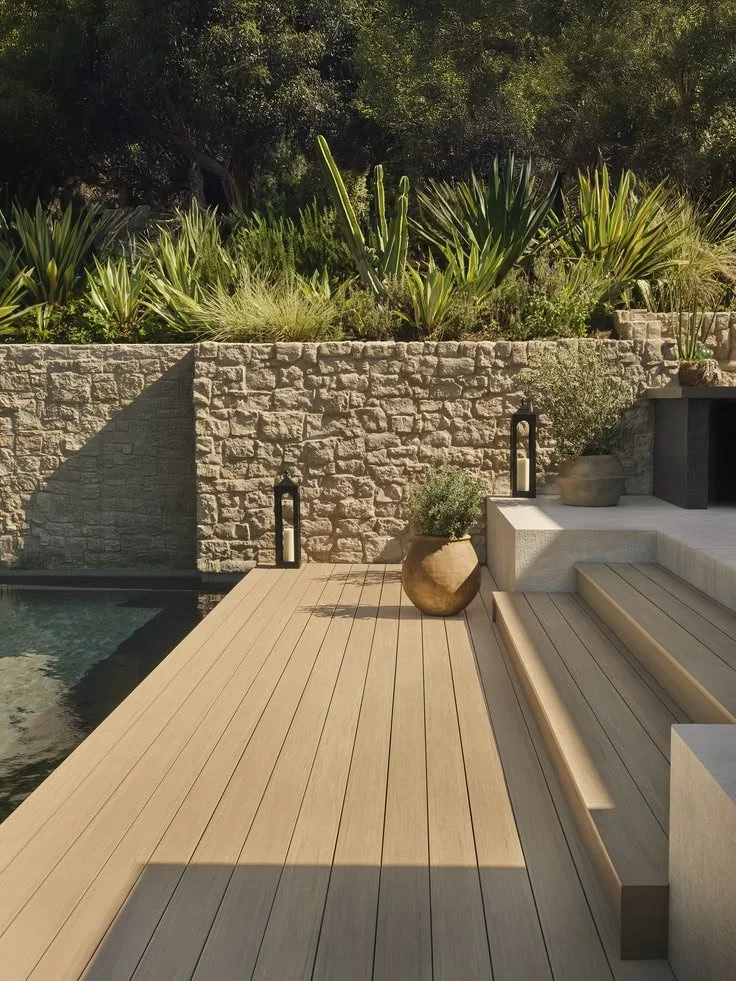
A truly relaxing backyard feels cohesive. You shouldn’t “notice” the boundaries between patio, lawn, path, and garden beds—your mind should glide through the space.
When transitions are neglected, though, the yard starts to feel fragmented. Examples include:
A clean stone patio leading into a stained or streaked concrete path
Fresh grass bordered by crumbling edging
A deck surface that clashes visually with the surrounding stonework
Two adjacent materials that have aged at different rates (one bright, one faded)
Your brain prefers continuity. Abrupt changes in texture, color, and condition create a subtle sense of disorder—even when everything is technically functional.
How to improve transitions without rebuilding everything
Use complementary tones and textures: If one surface is cool gray, avoid introducing a warm red-brown beside it without a connector.
Maintain consistent cleanliness: A single dirty strip can make the entire yard feel off-balance.
Repair borders and edges: Crisp edges signal intention and care.
Add “connector” elements: Gravel strips, low planting bands, or repeated planters help tie zones together.
In design terms, transitions are where calm is won or lost.
No. 5
Why Clean Surfaces Matter More Than You Think
Cleanliness is one of the strongest predictors of whether a space feels relaxing. Not “perfect,” not “sterile”—but clean enough that your mind reads the environment as maintained and safe.
When patios and walkways show stains, mildew, or grime, they broadcast a message: this space is slipping. Even if your furniture is beautiful and your plants are thriving, dirty hardscapes can drag everything down.
The good news is that this is one of the most efficient improvements you can make. In many cases, a deep clean can reset the entire mood of the yard in a single day. For example, professional help like power washing companies in Wheaton for patios can remove years of buildup, brighten surfaces, and restore visual clarity—without changing the layout or replacing materials.
Benefits of deep-cleaning patios, pavers, and paths
Restores original color and contrast
Improves curb appeal instantly
Reduces slip hazards from algae/moss
Makes the whole yard feel “finished” again
Encourages you to use the space more often
If your backyard feels less relaxing than it used to, cleaning is often the highest-return first step.
No. 6
How Lighting and Shadows Can Increase Visual Stress
Lighting doesn’t just make a yard usable at night—it defines the mood. And when surfaces are worn, stained, or cluttered, lighting can unintentionally exaggerate problems.
Here’s how:
Dirty areas absorb light unevenly, creating dull patches
Stained concrete can look harsher under bright white bulbs
Clutter creates jagged shadows that add to the sense of chaos
Inconsistent lighting between zones makes transitions feel abrupt
By contrast, when surfaces are clean and design elements are cohesive, light reflects more evenly, and your yard feels open and calm.
Quick lighting upgrades that change the atmosphere
Start with maintenance: Clean surfaces so they reflect light naturally.
Simplify the scene: Remove or consolidate clutter that casts messy shadows.
Use warm, soft lighting: Think warm-white path lights, sconces, and string lights rather than harsh flood tones.
Highlight movement paths: Gentle illumination on walkways and edges makes the yard feel intentional and safe.
Layer lighting: Combine path lights, ambient glow, and a few focal highlights (a tree, a feature wall, a planter).
Lighting is emotional architecture—done well, it makes your yard feel like a destination.
No. 7
Small Fixes That Make a Big Difference (Without a Full Renovation)
A calmer backyard is usually the result of a few targeted improvements, not a total rebuild.
If you’re feeling overwhelmed, use a simple sequence that builds momentum:
Step-by-step reset checklist
Declutter: Remove what doesn’t belong; store what you need; donate what you don’t.
Clean hardscapes: Patio, paths, edging, retaining walls—restore brightness and contrast.
Repair safety issues: Level stones, fix cracked areas, sand rough wood, tighten loose borders.
Unify the visual language: Repeat materials, colors, and shapes so the yard feels designed.
Add comfort deliberately: Upgrade cushions, add one outdoor rug, and introduce shade where needed.
Finish with light: Warm illumination makes everything feel calmer after sunset.
You’re not chasing perfection—you’re restoring ease.
No. 8
Restoring the Calm: Rebuilding a Backyard That Actually Feels Like a Retreat
If your backyard feels less relaxing than it used to, it’s rarely because you “stopped liking it.”
More often, time has quietly introduced friction:
Visual clutter overwhelms the senses
Discoloration signals neglect
Wear and tear creates physical unease
Poor transitions fragment the experience
Dirty surfaces dull the entire atmosphere
Harsh lighting exaggerates every inconsistency
The solution isn’t complicated, but it does require intentionality. When you simplify, restore, and unify, your yard becomes what it was meant to be: a space that gives something back to you.
Takeaways
A relaxing backyard depends less on size or expensive features and more on how the environment reads and feels day to day. In this article, we explored how visual clutter creates mental noise, how discoloration and buildup quietly age outdoor surfaces, how wear and uneven footing introduce physical tension, and why clean transitions and thoughtful lighting are essential to a cohesive, calming outdoor experience.
Start with decluttering and surface restoration (often the fastest transformation), then repair key problem areas and unify the design with consistent materials, colors, and warm lighting. With a handful of targeted changes, your backyard can feel peaceful, inviting, and restorative again.
Looking for Home resources?
Looking to enhance your living space and create a sanctuary that supports your well-being? Explore our home partners who offer a wide range of resources to elevate your home environment.